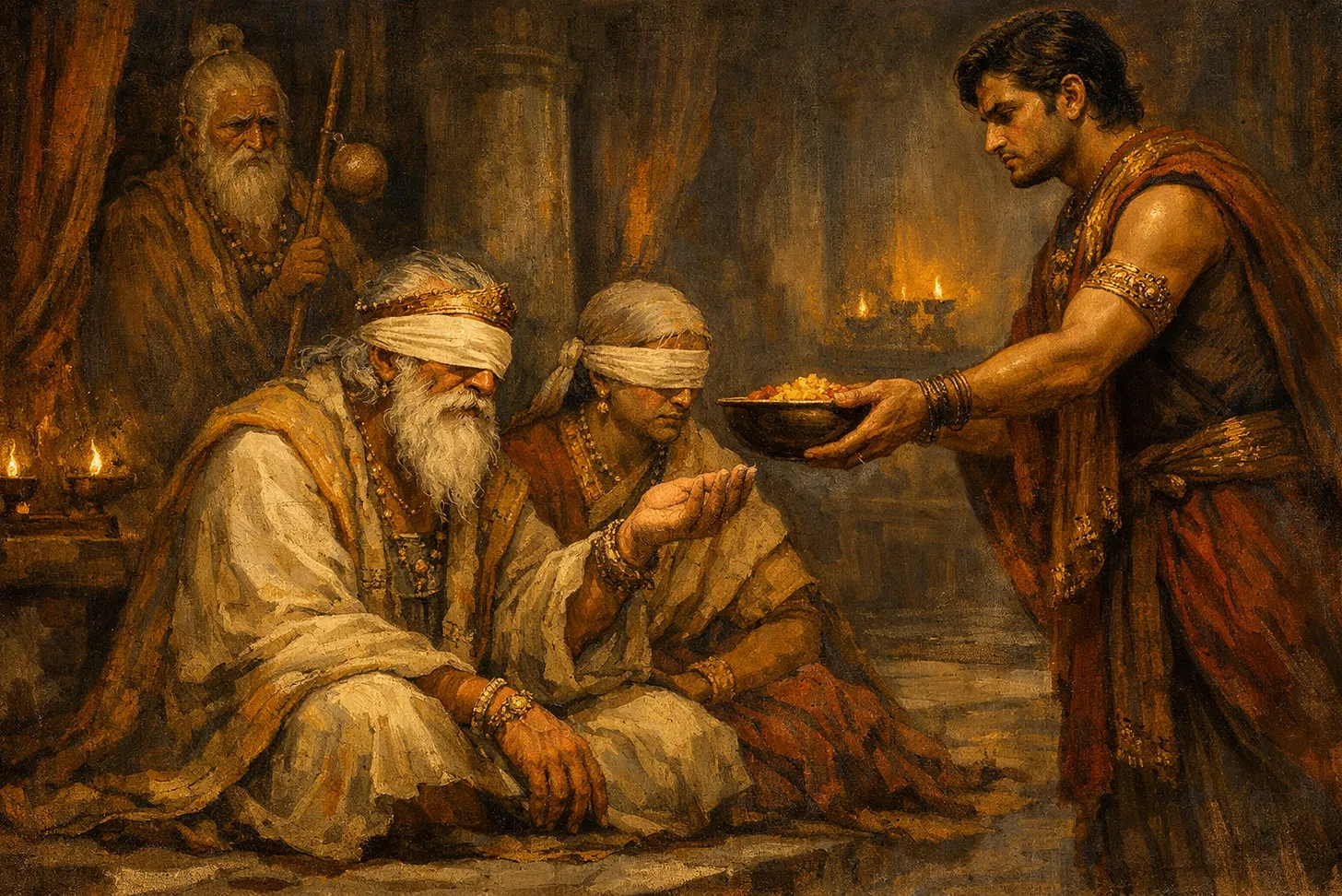
There is a moment in every life when the world one has clung to so desperately begins to reveal itself as a cage. For most of us, this revelation comes quietly and obliquely, through the slow erosion of health, the departure of loved ones, and the dawning recognition that what we called our life was, in large measure, a story we told ourselves. For Dhritarashtra, the aged and sightless king of the Kauravas, this moment arrived through something far more brutal: the voice of Bhima, raised in mockery, recounting with relish how he had slain the hundred sons of the blind king even as he handed him his daily meal.
The Mahabharata is unlike any other text in human civilization. It speaks about dharma in two registers simultaneously. In one register, it is thunderously emphatic. The great war of Kurukshetra stands as its most vivid sermon, a catastrophe of world historical proportions arising entirely from the failure to honor righteousness. Kingdoms fall, bloodlines are extinguished, and the earth itself weeps. The lesson could not be louder.
But the Mahabharata is equally a master of whispers. Beneath the epic battles and divine discourses, it conducts a second and subtler conversation about the interior life, about grief, attachment, dignity, the hour of renunciation, and the precise moment when clinging to what was must give way to what must be. The story of Dhritarashtra’s vanaprastha, his departure into the forest, belongs entirely to this second register. It is the Mahabharata at its most intimate, and perhaps at its wisest.
In the Shadow of Defeat
After the Kurukshetra war, the Pāṇḍavas did something extraordinary. They could easily have cast aside Dhritarashtra, the blind old king whose attachment to Duryodhana and failure to restrain injustice had helped destroy an entire generation. Instead, as described in the Mahabharata, they treated him with deep honor for fifteen years. Yudhishthira placed him at the head of the household, sought his counsel in royal affairs, and ensured that he lacked nothing. Fine food, rich garments, ornaments, comfortable beds, and every royal comfort were provided to him. Gandhari was served with devotion by Kunti, Draupadi, Subhadra, and the women of the palace as though she were their own mother.
Whenever Dhritarashtra wished to perform rites for his dead sons and relatives, Yudhishthira quietly arranged all the required wealth, offerings, gifts, and ceremonies without the slightest resentment. To Yudhishthira, Dhritarashtra was not merely an elder. He was still a father figure and a guru deserving reverence despite the past.
Yet beneath this atmosphere of duty and compassion, another truth endured. Bhima could never forget. The humiliation of the dice game, the poisoning attempt, the years of exile, and above all Draupadi’s public humiliation burned within him even after victory. Though he obeyed Yudhishthira outwardly, Bhima repeatedly found ways to wound the old king. While serving him food or attending to him, he would loudly boast that these very arms had slain Duryodhana and all the Kaurava brothers. These were not careless remarks but deliberate reminders aimed at a grief-stricken father.
Dhritarashtra endured this in silence. For fifteen years he lived surrounded by royal comfort, affection, and respect, yet also by the unbearable memory of his dead sons, sharpened daily by Bhima’s words. In the end, it was this life of inward humiliation and exhaustion that ripened into vairāgya. The palace itself became a forest of grief, and the old king finally understood that the time had come to renounce the world and depart for the forest with Gandhari.
The Blindness That Was Not of the Eyes
The Mahabharata repeatedly returns to the image of blindness. Dhritarashtra was born blind because his mother Ambika closed her eyes in fear during Vyasa’s niyoga ritual. Gandhari then chose to blindfold herself for life. At the center of the Kuru dynasty stood two people without sight, yet deeply attached to their own understanding of the world.
When Vidura returned from pilgrimage and heard Bhima’s cruel taunts, he did not respond with anger. Instead, he reminded Dhritarashtra of Vyasa’s old warning that the world was declining and that true wisdom lay in turning inward rather than clinging to fading power and comfort. That counsel had gone ignored, and now the Kuru race lay destroyed.
Vidura pointed out that Dhritarashtra had become more blinded by attachment than by the loss of his eyes. He was living on food given by the very men who had slain his sons, enduring humiliation simply to continue living. Desire, Vidura said, traps people within “I” and “mine,” unable to let go.
Yet his words were compassionate. He was asking Dhritarashtra to finally see with understanding. The Mahabharata suggests that the deepest blindness is not physical blindness, but attachment, entitlement, and refusal to accept reality.
The Subtle Dharma of Knowing When to Stop
Here the Mahabharata reveals one of its most subtle teachings. Dharma is not only about fulfilling duties as a king, warrior, or householder. It is also about knowing when a stage of life has ended, when to stop clinging to power, comfort, and identity, and when to step away with wisdom rather than defeat.
The ancient āśrama system understood life as a progression through stages: student, householder, forest dweller, and renunciant. Vanaprastha was not escape or punishment. It was the recognition that worldly responsibilities had reached their natural end, and that continuing to cling to them could itself become adharma.
Dhritarashtra finally arrives at this understanding in the Mahabharata. He openly admits his failures: denying the Pāṇḍavas their rightful inheritance and allowing Duryodhana’s ambition to prevail despite the warnings of Vidura, Bhīṣma, Droṇa, Kṛṣṇa, and Gandhari. Yet vanaprastha asks for more than guilt. It asks for clarity.
Dhritarashtra recognizes that the part of his life tied to the world is over. Yudhishthira has cared for him with extraordinary kindness, he has completed the rites for his sons, and now it is time to let go and depart for the forest.
A Retired King's Final Counsel
In the Mahabharata, Dhritarashtra does not leave for the forest immediately after deciding to renounce the world. Instead, he first seats Yudhishthira beside him and offers detailed counsel on kingship. He speaks about self-control, wise ministers, protecting cities, guarding secrets, punishing corruption fairly, ruling through dharma, and preserving the welfare of the people. He says that protecting subjects through righteousness brings greater merit than even a thousand Aśvamedha sacrifices.
There is deep irony in this scene. Dhritarashtra clearly understood the principles of good governance, yet failed to follow them when blinded by attachment to his sons. Having suffered the consequences, he could now speak with clarity and humility. Yudhishthira accepted his words with reverence, saying that after Bhīṣma and Kṛṣṇa, no guide remained to him except Dhritarashtra.
Before departing, Dhritarashtra also wished to complete his worldly obligations. He gathered the citizens, praised Yudhishthira’s rule, asked forgiveness for the wrongs committed by himself and his sons, and entrusted the kingdom to the Pāṇḍavas. The people wept, while the brāhmaṇa Sāmba reminded them that the destruction of the Kurus had ultimately been shaped by destiny.
Dhritarashtra then performed magnificent śrāddha rites for the dead warriors of the war and distributed enormous gifts of food, gold, cattle, villages, garments, and wealth to brāhmaṇas and the poor. Yudhishthira ordered that even more be given than requested. After ten days of charity and ritual, Dhritarashtra finally felt free of his obligations to his sons, ancestors, and lineage, and only then was he ready to leave for the forest.
When Harsh Words Become Grace
The Mahabharata does not moralize clumsily. It does not reduce Dhritarashtra into a simple villain finally receiving punishment. Instead, it follows the long unfolding of a human life shaped by attachment, grief, blindness, and finally insight. His suffering is neither denied nor simplified. It becomes the very ground from which understanding slowly emerges.
As Vidura perceived, Bhima’s harsh reminders were not merely acts of cruelty. Over fifteen years, they became instruments of awakening. What first appeared only as humiliation gradually forced Dhritarashtra to confront the truth he had spent his life avoiding. The desire to continue living, jīvitāśā, had bound him to comfort, memory, and identity. Yet once that attachment was honestly seen, detachment quietly arose within it. The life he had clung to no longer appeared as something to possess, but something that could finally be released.
Vaishampayana later teaches that all beings arise from the unseen and return to it, and that every action bears its proper fruit. True freedom belongs to the one who comes to know himself clearly. Dhritarashtra, though born physically blind, had spent most of his life blinded more deeply by attachment and entitlement. Only in the end, after counsel had been given, duties completed, charity performed, and grief acknowledged, did he finally understand that the world had never belonged to him at all. Letting go was not defeat. It was liberation.
This is the subtle dharma the Mahabharata teaches through his story. Not the dharma of battles and vows, but the dharma of the inner season. Dharma of knowing, with clarity and without bitterness, that it is time to go.
Inspired by this, I have taken the creative liberty to alter a popular prayer thus
“अन्धं दर्शयते मार्गं पङ्गुं लङ्घयते गिरिम् । यत्कृपा तमहं वन्दे परमानन्दमाधवम् ॥”
By the grace of Mādhava, even the blind are shown the path, the mute find speech, and the crippled gain the strength to cross mountains.
Krishnārpaṇamastu.
May all that was understood, misunderstood, written, remembered, and released find its resting place at the feet of Krishna.
Sources : Ashramavasa Parva of Mahabharata (https://www.vyasaonline.com/ashramavasika-parva/) and Chapter titled ‘ಕುರುಡನ ಲೋಕದ ಮೋಹ ಕಣ್ಣಿದ್ದವರಿಗಿಂತ ಮಿಗಿಲು’ from Lakshmeesha Tolpadi’s Sampige Bhagvatha. English translation here - https://open.substack.com/pub/smithahs/p/chapter-12-the-blind-man-desires?r=ggg1n&utm_campaign=post-expanded-share&utm_medium=web